


Medicare Advantage (Part C) replaces Original Medicare with a private plan that bundles hospital, medical, and usually drug coverage often at a $0 monthly premium, but with network restrictions and variable out-of-pocket costs. Medicare Supplement (Medigap) works alongside Original Medicare, filling in cost gaps like deductibles and coinsurance, giving you nationwide provider access and more predictable costs at a higher monthly premium. You cannot have both at the same time, so this choice is one of the most important you’ll make when you first enroll in Medicare.
You’ve just turned 65 or you’re a few months away and someone hands you a stack of mail about Medicare. Half of it says Medicare Advantage. The other half says Medicare Supplement. Both sound like they’ll take care of you. But they work very differently, and choosing the wrong one at the wrong time can be costly to undo.
Here’s what I tell clients in Tulsa every week: this is not a decision about which plan sounds better. It’s a decision about how you want to pay for healthcare, how much flexibility you need, and how much financial uncertainty you can absorb. This post breaks down the real differences so you can walk into your enrollment window with clarity.
We’ll cover how each plan type works, compare costs side by side, look at the trade-offs honestly, and help you figure out which fits your situation.
What Is the Difference Between Medicare Advantage and Medicare Supplement?
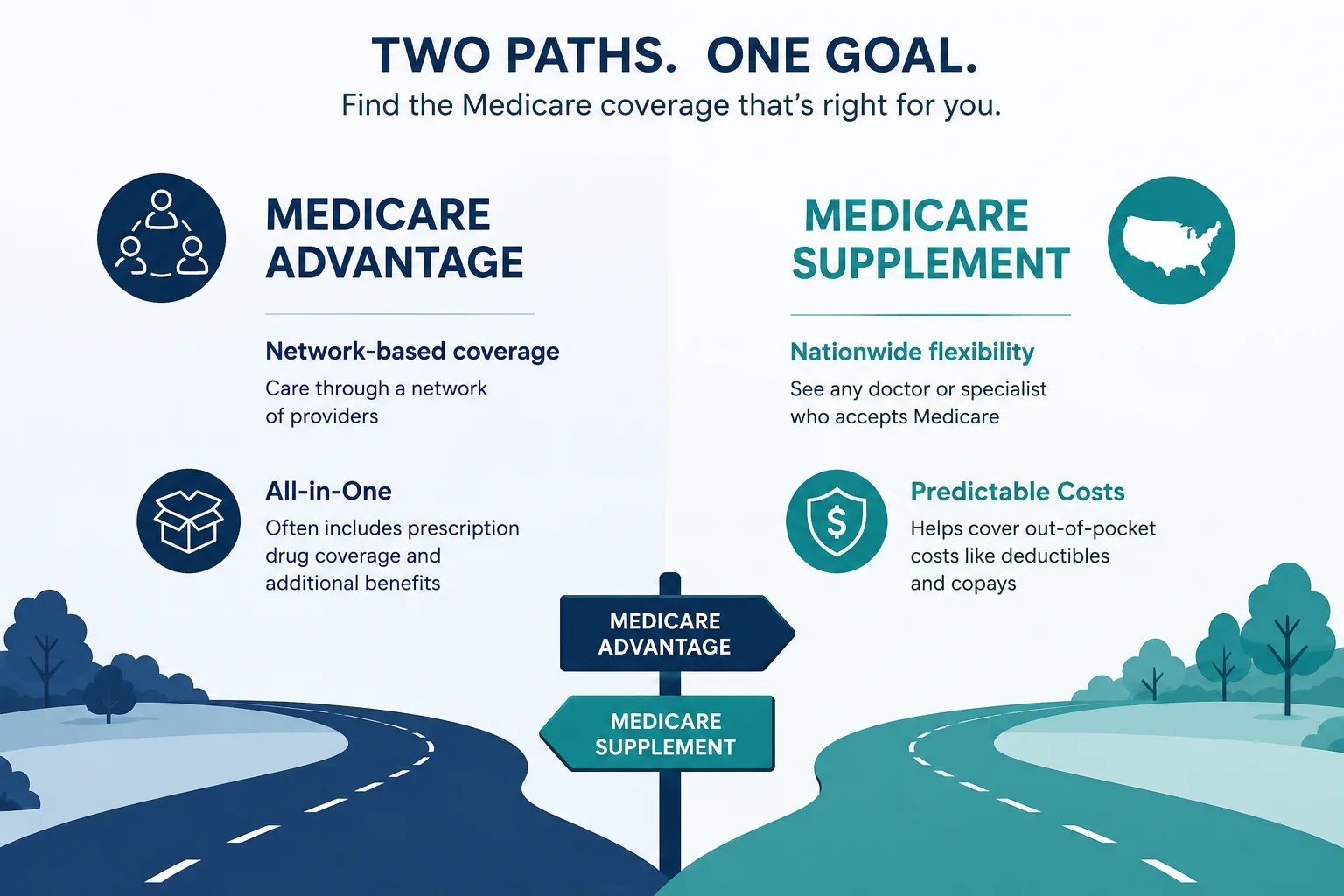
These two plan types solve the same problem Original Medicare alone doesn’t cover everything but they do it in opposite ways.
Medicare Supplement (also called Medigap) pairs with Original Medicare. You keep your Part A and Part B, and the Medigap policy pays the gaps: deductibles, coinsurance, hospital copays. You can see any doctor in the country who accepts Medicare, no referrals needed, no network to worry about.
Medicare Advantage (Part C) takes a different approach. You still technically have Medicare, but a private insurer handles your benefits through their own plan. Most Advantage plans are HMO or PPO networks meaning your access to doctors and hospitals is limited to who’s in the plan. Most plans bundle prescription drug coverage and extras like dental, vision, and gym memberships.
One Important Rule
Federal law doesn’t allow you to have both Medicare Advantage and a Medigap policy at the same time. You choose one path or the other when you enroll.
How Do the Costs Compare in 2026?

Cost is usually the first thing people ask about, and it’s also where most of the confusion lives. Here’s why: both plan types involve the Part B premium ($202.90/month in 2026), but they layer costs on top of it very differently.
| Feature | Medicare Advantage (Part C) | Medicare Supplement (Medigap) | Key Takeaway |
| Monthly Premium | $0–$53 avg (plus Part B) | $130–$200+ avg (plus Part B) | Advantage lower upfront |
| Out-of-Pocket Max | Up to $9,350 in-network (2026) | As low as $283/yr (Plan G) | Supplement more predictable |
| Provider Access | Network only (HMO/PPO) | Any Medicare-accepting doctor | Supplement more flexible |
| Drug Coverage | Usually included | Requires separate Part D | Advantage more bundled |
| Dental/Vision/Hearing | Often included | Not included | Advantage extra perks |
| Prior Authorization | Required for some services | Not required | Supplement fewer hurdles |
| Switching Later | Can switch annually at AEP | Medical underwriting may apply | Supplement harder to regain |
The cost structure boils down to this: Medicare Advantage tends to cost less when you’re healthy. Medicare Supplement tends to cost less when you’re sick. If you have a hospital stay, a surgical procedure, or a serious diagnosis, Advantage’s out-of-pocket maximum up to $9,350 in-network for 2026 can be reached quickly. A Medigap Plan G policyholder, by contrast, pays only the $283 Part B deductible for the year and then nothing more.
For a Tulsa resident on a fixed income, that predictability can matter a great deal.
What Are the Trade-Offs I Should Know?
Both plan types have real advantages and real limitations. Here’s an honest look at each.
Medicare Advantage: The Pros and Cons
- Lower monthly premiums (many plans in Oklahoma run $0 beyond the Part B premium)
- Extra benefits: dental, vision, hearing, fitness memberships included in many plans
- Drug coverage bundled in (no separate Part D needed)
- Annual out-of-pocket maximum caps your worst-case costs
- But: prior authorizations can delay care for procedures like surgery or imaging
- But: your doctor network can change year to year
- But: if you switch to Medigap later, you’ll likely face medical underwriting
Medicare Supplement: The Pros and Cons
- See any doctor who accepts Medicare no network restrictions, nationwide
- Predictable costs: once you pay your premium and deductible, surprises are rare
- No prior authorization requirements for Medicare-approved services
- Plans are standardized Plan G from one company covers the same things as Plan G from another
- But: monthly premiums are higher, typically $130–$200+ in Tulsa for Plan G at age 65
- But: you need a separate Part D plan for prescriptions
- But: dental, vision, and hearing aren’t included
What Should I Consider Before Deciding?

There’s no universal right answer. Here are the questions worth sitting with.
How often do you use healthcare? If you see specialists frequently, manage a chronic condition, or take multiple medications, Medigap’s predictable costs often make more financial sense over time. If you’re in excellent health and rarely need care, a $0-premium Advantage plan may work well for years.
Do you travel? If you spend winters somewhere warm or travel frequently, a Medicare Supplement plan covers you anywhere in the country. Many Advantage plans are region-based, which can leave you paying out-of-network rates away from home.
Can you absorb a high out-of-pocket year? Ask yourself honestly: if your health took a serious turn, could you cover up to $9,350 in a single year? If not, the cost predictability of a Medigap plan may be worth the higher monthly premium.
Are you in your Medigap Open Enrollment window? When you first enroll in Medicare Part B at 65, you have a six-month window during which insurers cannot deny you a Medigap policy or charge more due to pre-existing conditions. That window doesn’t come back. Once it closes, switching to Medigap typically requires answering health questions and approval isn’t guaranteed.
A Real Example: Two Tulsa Residents, Two Different Choices
Rita is turning 65 in Tulsa. She’s in good health, has no chronic conditions, and is watching her budget carefully. She enrolls in a Medicare Advantage plan with a $0 premium, covers her prescriptions through the plan, and uses her included dental benefits. Her annual cost stays manageable because she rarely needs significant care.
David, also turning 65, has Type 2 diabetes, sees a cardiologist regularly, and travels several months a year to see family out of state. He enrolls in Medicare Supplement Plan G. His monthly premium is about $165, but he knows exactly what he’ll owe each year. When he’s visiting family in another state and needs a specialist visit, he’s covered.
Neither choice is wrong. They’re right for different lives. The key is making the decision based on your situation not the loudest mailer in your mailbox.
Frequently Asked Questions
Can I have both Medicare Advantage and Medicare Supplement at the same time?
No. Federal law prohibits having both simultaneously. Medicare Supplement policies work with Original Medicare, not Medicare Advantage. You choose one path and if you start with Advantage and want to switch to Medigap later, you may need to pass medical underwriting to qualify.
Which Medicare plan is cheapest?
It depends on how much healthcare you use. Medicare Advantage plans often have $0 monthly premiums, but you pay copays and coinsurance each time you receive care. Medicare Supplement plans have higher monthly premiums but cover most of those costs after your deductible. For healthy individuals who rarely need care, Advantage often costs less. For those with regular medical needs, Medigap frequently costs less overall.
What is the most popular Medicare Supplement plan in 2026?
Plan G is currently the most popular Medigap option, held by about 39% of all Medigap enrollees. After you pay the $283 Part B deductible, Plan G covers 100% of Medicare-approved costs. It’s available to anyone who became eligible for Medicare on or after January 1, 2020.
Can I switch from Medicare Advantage to Medicare Supplement later?
Yes, but it’s more complex than switching in the other direction. To get a Medigap plan, you’ll need to drop your Advantage plan, return to Original Medicare, and apply for Medigap through a private insurer. In most states, insurers can use medical underwriting during this process meaning they can deny coverage or charge higher premiums based on your health history. This is why the timing of your initial decision matters so much.
Does Medicare Advantage cover me when I travel?
Most Medicare Advantage plans provide emergency and urgent care coverage nationwide, but routine care is typically limited to your plan’s network. If you travel frequently or spend extended time in another state, a Medicare Supplement plan which covers you anywhere Medicare is accepted may be a better fit.
Making a Confident Medicare Decision
Medicare Advantage and Medicare Supplement both have a place. One isn’t better than the other in every situation it depends on your health, your budget, your travel habits, and how you feel about financial predictability versus flexibility.
What I’ve seen consistently working with clients throughout the Tulsa area is that the people who feel best about their Medicare decision are the ones who had a real conversation about their situation before enrolling not the ones who simply picked the plan with the lowest monthly premium or the flashiest benefits package.
If you’re turning 65 soon or reviewing your current Medicare coverage, I’m happy to talk through your options at no cost and with no pressure. You can schedule a free consultation or visit our services page to explore coverage options. My office is open Monday through Thursday, 9:00 AM to 4:00 PM, and I work with individuals throughout the Tulsa area.